· By Buffy
The Tourbillon
Breguet's 1801 patent: a rotating cage that averages gravity's mischief — what it really does, why wristwatches arguably don't need it, and why we love it anyway.
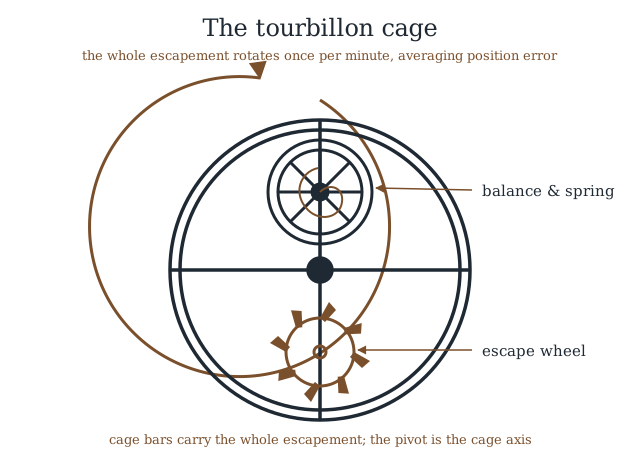
The tourbillon (French: whirlwind) is a cage carrying the entire escapement and balance assembly, rotating once per minute (typically), so that positional errors average out over each revolution. Patented by Abraham-Louis Breguet on 26 June 1801 (7 Messidor, Year IX) — and argued about ever since.
The physics it attacks
A watch hanging in a pocket holds its balance in one orientation for hours; gravity then pulls the balance’s center of mass consistently off-axis, producing a steady positional rate error (details). Breguet’s insight: if the escapement rotates through all vertical positions each minute, the errors average to nearly zero.
It is a genuinely clever, purely mechanical averaging algorithm.
Does it help a wristwatch?
The honest debate:
- The case for: wristwatches do move through positions, and fine tourbillons have won chronometer competitions into the modern era (e.g. observatory trials and modern certifications). A one-minute tourbillon in a wristwatch still averages the vertical positions it spends time in.
- The case against: the wrist already randomizes position; the lever escapement is already detached; and adding a cage costs energy (amplitude) and adds mass and fragility. Some tests show wrist tourbillons improving averages barely or not at all.
- The verdict of the market: irrelevant. The tourbillon is the visible soul of the craft — a spinning heart you can watch — and it has become the canvas where watchmakers show what they can do (multi-axis cages, flying tourbillons without an upper bridge, tourbillons inside tourbillons).
Cousins and variants
- Carrousel (Bonniksen, 1892): same averaging goal, but the cage is driven by the train rather than carrying the escapement on its own axis; cheaper to make historically, Danish-British origin.
- Flying tourbillon: cantilevered cage, no upper pivot — the full spectacle.
- Multi-axis tourbillons: average in all planes; beautiful, energy-hungry, rare (Greubel Forsey, Jaeger-LeCoultre Gyrotourbillon).
If you want accuracy per dollar, buy certification. If you want to see the 1801 patent still spinning, nothing else will do.